
Your Business Has Data. But Does It Have Intelligence?
August 18, 2026



 By Kumar Kaushik
Your business generates data every single day.
The amount of data keeps growing. But here is the uncomfortable question:
Is all that data actually helping your business make better decisions?
Because having data and having intelligence are two completely different things.
A company can have terabytes of information and still struggle to answer simple questions:
If your team still needs hours of manual work to find these answers, you may have a data problem disguised as a business problem.
Think about a typical growing business.Data may exist in:
Each system may contain valuable information. But there is a catch.
And someone eventually spends hours combining everything manually. At that point, the business technically has data. But it doesn't necessarily have intelligence.
This distinction matters. Data tells you what happened, information gives context to what happened, and intelligence helps you understand what it means and what you should do next. For example, data may tell you that 1,200 customers purchased a product last month. Information adds context by showing that 65% of those customers came from three major regions. Intelligence goes a step further by revealing that customers in one of those regions are showing a significant increase in repeat purchases, suggesting an opportunity to expand sales and marketing investment there. The first statement gives you a number, the second gives you context, and the third gives you a business decision. That is the real value of data.
Modern businesses are exceptionally good at collecting information. Every click can become data, every transaction can become data, every customer interaction can become data, and every application event can become data. But collecting everything doesn't automatically create value. In fact, more data can sometimes create more confusion. Why? Because data alone doesn't tell you what matters, what is changing, what needs attention, or what action should be taken. The real advantage comes when businesses can transform scattered data into meaningful insights, identify patterns, understand what is happening, and turn that understanding into better, faster decisions.
Because without the right architecture, processes and analysis, businesses can end up with:
And when executives don't trust the numbers, something dangerous happens:
But intuition should not have to compete with reliable business intelligence.
Poor-quality data doesn't always look like a technical problem. Sometimes it looks like:
The technical issue may be a duplicate record. The business consequence can be lost revenue, wasted time or a poor customer experience. That's why data quality is not simply an IT responsibility. It is a business responsibility.
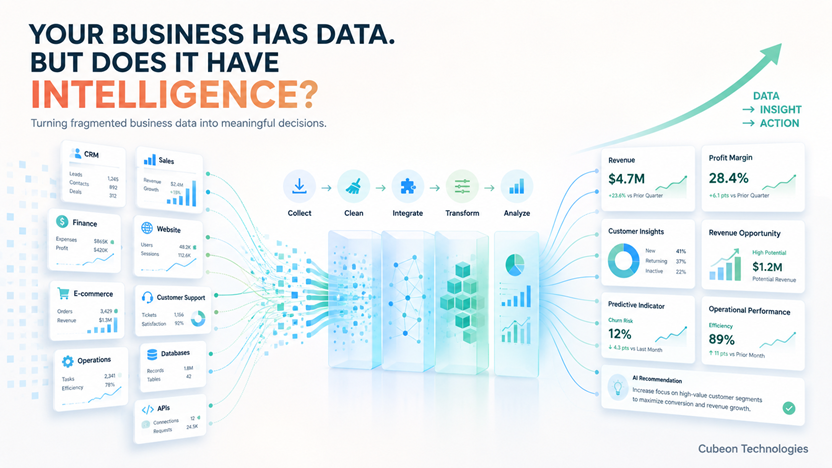
A truly data-driven business doesn't simply have more dashboards. It has a connected flow:
Collect → Clean → Integrate → Transform → Analyze → Understand → Act
Each stage matters.
Capture data from the systems where business activity happens.
Remove duplicates, correct inconsistencies and improve data quality.
Combine data from different sources into a unified view.
Convert data into a format that is suitable for analysis.
Examine data to identify patterns, trends, and insights.
Interpret the results of the analysis to inform decision-making.
Use those insights to make faster and smarter decisions. The final step is the one that matters most. Data that never influences a decision is simply stored information.
This is where many businesses get confused. They build a beautiful dashboard filled with graphs, charts, KPIs, percentages, and real-time numbers. It looks impressive, but then the CEO asks, “So what should we do?” — and there is silence. A dashboard can tell you what happened, while business intelligence should help you understand why it happened. Advanced analytics can help you explore what could happen next, and intelligent systems can help organizations determine what action should be considered. The goal isn’t to create more charts; the goal is to create better decisions.
Imagine opening your business dashboard and asking, “Which customers are most likely to purchase again this month?”, “Which products have declining margins?”, “Where are operational bottlenecks increasing?”, “Which marketing channel is generating the highest-value customers?”, or “What changed compared with the previous quarter?” Instead of spending hours collecting, cleaning, and organizing information, your team can focus that time on understanding the business, identifying opportunities, and making better decisions. That’s where data engineering, analytics, automation, and AI begin to work together—transforming raw business data into meaningful insights, actionable intelligence, and smarter business outcomes.
People often notice the dashboard. They notice the charts. They notice the AI interface. They rarely notice what makes those systems possible. Behind reliable intelligence is usually a strong data foundation.
Data engineering helps organizations build pipelines and systems that can:
Without a reliable foundation, even sophisticated analytics can produce unreliable results.
Bad data in. Bad decisions out.
Your competitors probably already have data—customer data, sales data, operational data, financial data, and marketing data. The real question is: **Who can turn that data into action faster?** Two companies can have almost identical datasets, yet one may review reports only once a month while the other continuously identifies trends, uncovers opportunities, and responds quickly. The difference isn’t necessarily the amount of data a company has; **it’s the ability to turn data into intelligence.** And that ability can become a powerful competitive advantage.
If several answers make you uncomfortable, that's not necessarily bad news.
It may simply mean your business has an opportunity.
The future isn't about collecting the most data; it is about **making the most sense of the data you already have**. Businesses that succeed with data will increasingly be the ones that can connect information, improve data quality, automate processing, and transform complex datasets into clear business decisions. That's where technology becomes more than software—it becomes a **decision-making advantage**.
At **Cubeon Technologies**, we believe data should do more than sit inside databases—it should help businesses understand what is happening, discover opportunities, and make better decisions. Our technology capabilities span areas such as **Data Engineering, Data Mining, Data Integration, Data Transformation, Analytics, Automation, and Custom Software Solutions**. Whether your data is distributed across multiple systems or you're starting to build a structured data foundation, the goal remains the same: **turn fragmented data into meaningful business intelligence**. Because your business doesn't need more data simply for the sake of having more data—it needs **better answers**.
If your organization can collect information but struggles to understand it, you don’t necessarily have a data shortage—you may have an **intelligence gap**. And closing that gap could fundamentally change how your business operates. The goal isn’t to collect more data blindly, but to **understand it intelligently, uncover meaningful insights, and make decisions with confidence**.
Talk to Cubeon Technologies about building the data engineering, integration, analytics and technology foundation your business needs.
Website: www.cubeontechs.com
Email: support@cubeontechs.com
August 18, 2026

August 11, 2026

July 10, 2026